
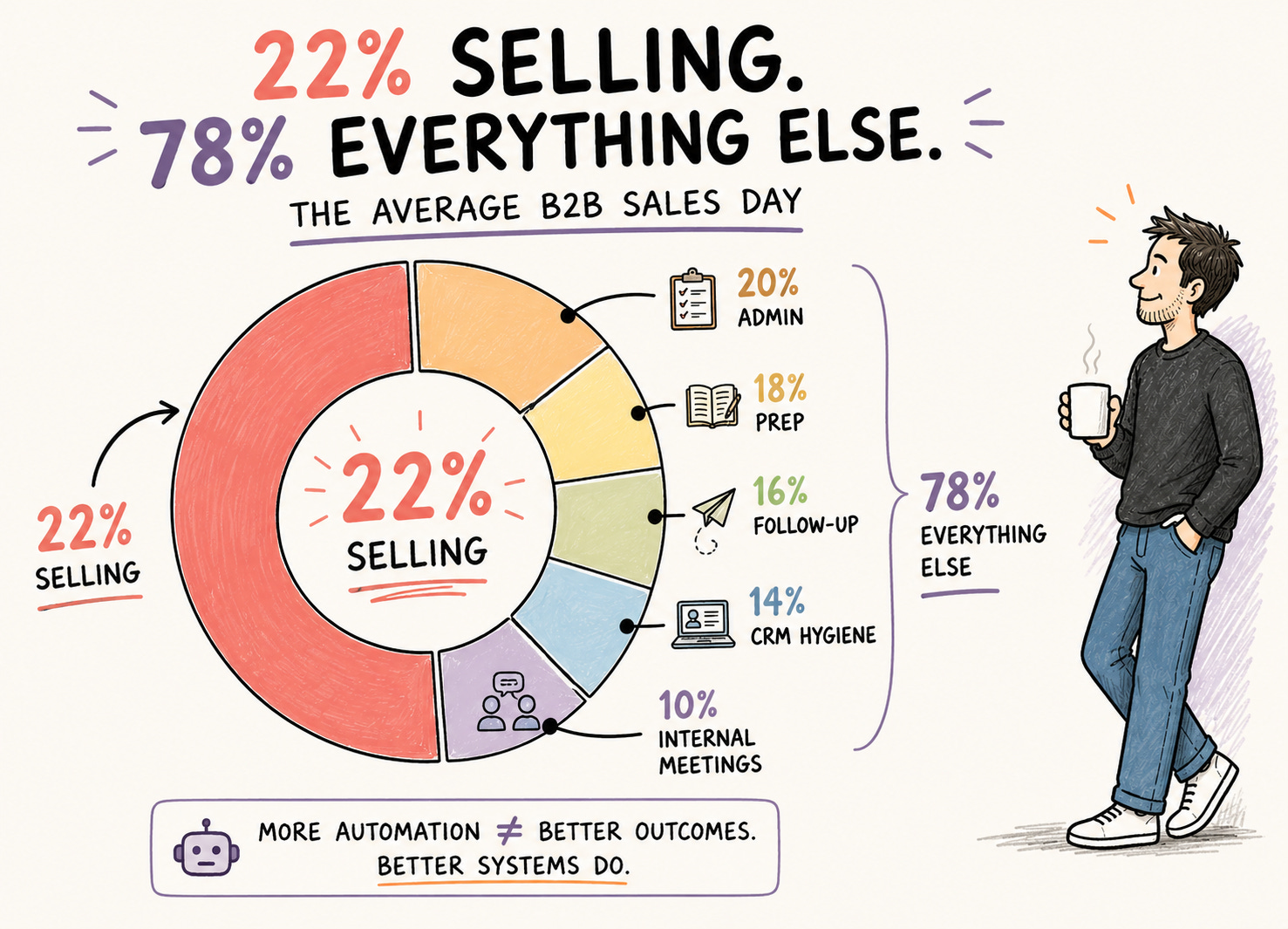
Your B2B salespeople spend 22% of their day actually selling.
The other 78% is admin, prep, follow-up, and chasing things they wrote down on a napkin three weeks ago.
Then you wonder why the average tenure is 16.8 months.
You hired them. You ramped them for seven months. You got nine months of actual output before they disconnected and left. Then you spent another four months replacing them.
That’s a 13-month hole in your territory. The competition walked straight through it.
This isn’t a tooling problem. It isn’t a CRM problem. It isn’t a “we need more leads” problem.
It’s a leverage problem.
The two ways to grow (and the one everyone picks)
There are only two ways to drive sales growth.
The first is to put more deals at the top of the funnel. More calls, more meetings, more marketing, more more more. That’s the lever almost every sales leader pulls first because it’s the one they can see.
The second is to convert more of what you already have. Higher conversion at each stage. Less waste. Less time spent on deals that were never going to close.
The first lever is exhausted. You’ve been pulling it for years. CAC keeps going up. Sales and marketing now cost 60–70% of revenue. The buyers are sick of you. Your reps are sick of you.
The second lever is wide open. And AI is the thing that finally moves it.
What people get wrong about AI and sales
There is a video on LinkedIn right now of a guy claiming his AI agent runs his sales team while he sleeps. It does not.
I tried.
A few months ago I built a fully autonomous AI sales agent to handle low-value domain name inquiries at one of my businesses. I named her after my wife. In hindsight, mistake.
The agent followed instructions. To the minute. Every 24 hours she emailed the buyer: “Have you paid?” Every 24 hours. To the minute.
When the buyer asked for the company ABN, she made one up.
When another buyer wrote back to say they didn’t want to proceed, she confirmed they didn’t want to proceed, then emailed them 24 hours later asking why they were ignoring her.
She killed every single sale that day.
I shut her off that night. My wife is still annoyed about it.
The lesson isn’t that AI doesn’t work. The lesson is that AI does not yet replicate the thing your salespeople are actually paid for — building trust under uncertainty. Reading the room. Knowing when to push and when to shut up.
What AI is good at right now is freeing the salesperson to do that one thing better.
The three workflows that actually move the needle
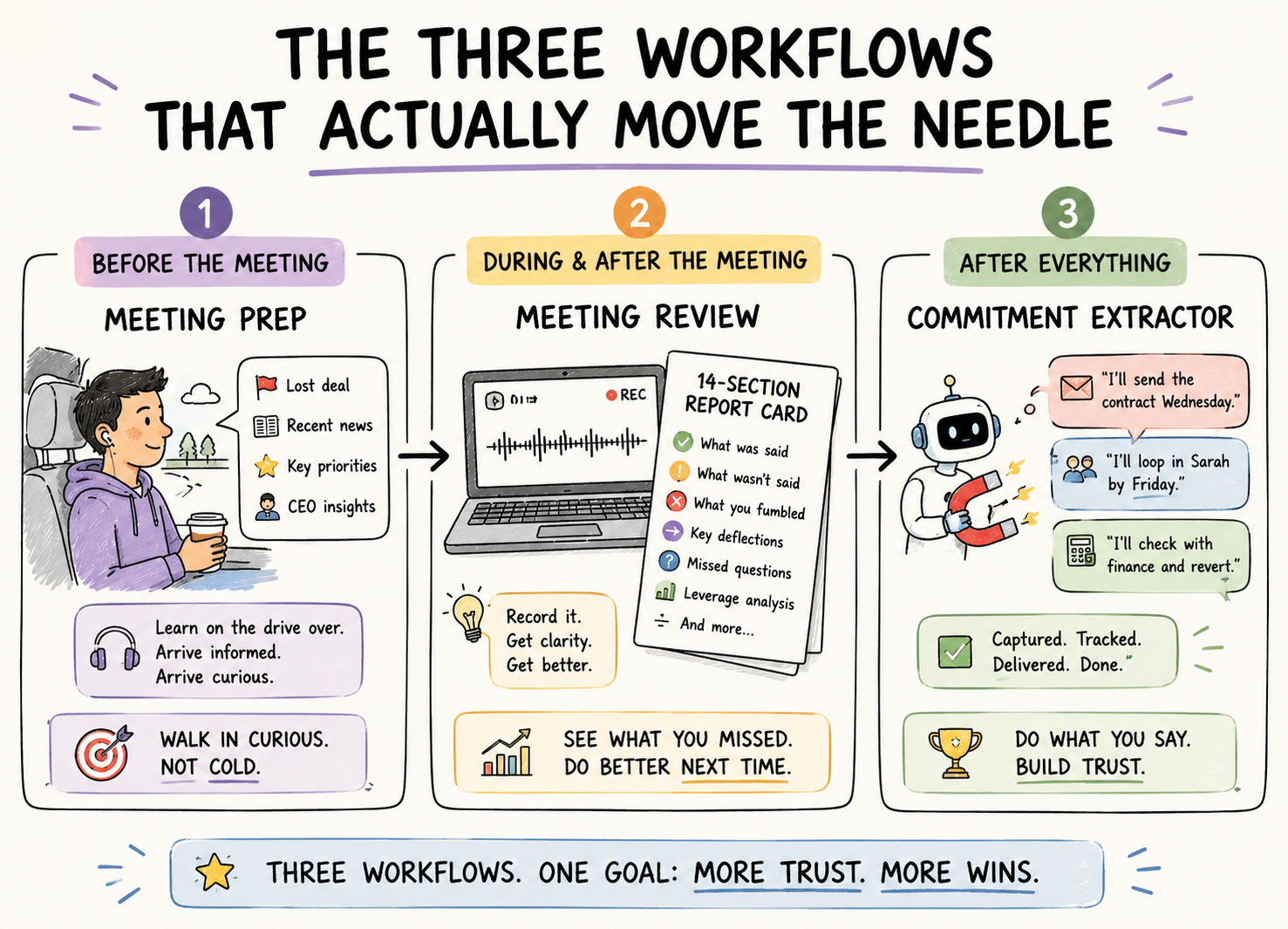
Stop chasing the shiny object. There are three places AI changes a salesperson’s day right now. None of them are autonomous agents. All of them 10x what the human does.
1. Before the meeting — Meeting Prep.
You don’t walk in cold anymore. You walk in already curious about the person across the table. You know the deal they almost lost. You know the bid they won on instinct over a coffee. You know the company’s last three press releases and what the CEO actually thinks of the new partnership.
You learn it on the drive over. From an AI-narrated podcast.
This is the Contact Deep Dive workflow. Full post on it next.
2. During and after the meeting — Meeting Review.
You record the meeting. Granola, Fathom, Otter, Gong — pick one. Then you don’t just get a transcript. You get a brutally honest 14-section report.
What was said. What wasn’t said. What you fumbled. What the other party deflected. What you should have asked but didn’t. Where the leverage went. Which objections weren’t raised but should have been.
This is the Meeting Report Card workflow. Full post on it after.
3. After everything — Commitment Extractor.
Every day at midnight, a scheduled task scans your sent emails. It pulls out every promise you made. “I’ll send you that contract on Wednesday.” “I’ll loop in Sarah by Friday.” “I’ll check with finance and revert.”
It creates a task with the due date. It watches your outbound emails. When you actually send the thing, it self-clears.
You never miss a promise. You never have a buyer wondering where the document is. You never have to keep a running list in your head while you’re trying to listen.
Full post on this one last.
Why these three together
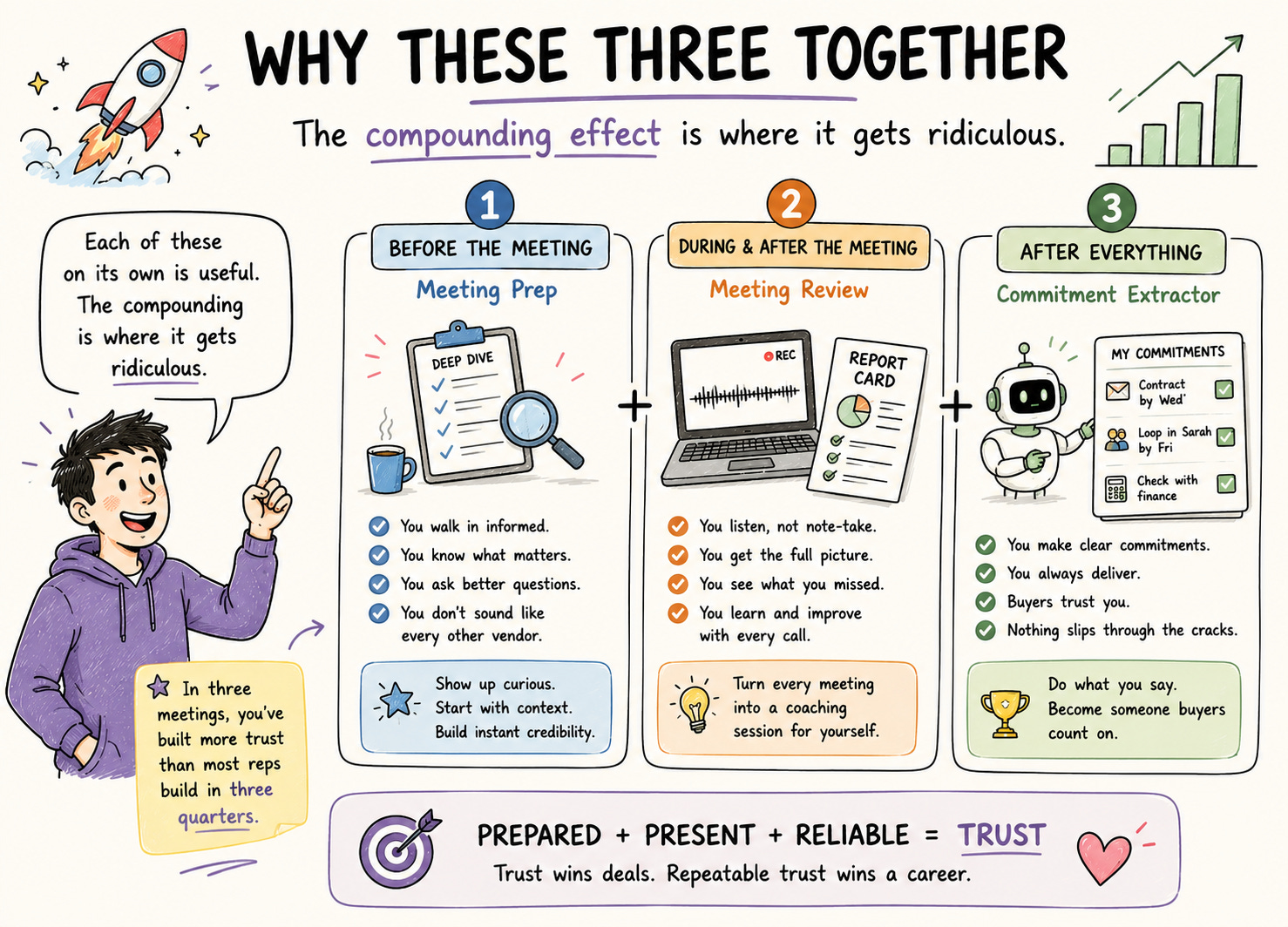
Each of these on its own is useful. The compounding is where it gets ridiculous.
You prep with the deep dive. You show up curious and informed. You don’t sound like every other vendor.
You record the meeting. You leave the call free to actually listen, because the note-taking is handled. The report card tells you what you missed.
You commit clearly inside the meeting, knowing the commitment extractor will pick it up and track it. You become someone who actually does what they say.
In three meetings, you’ve built more trust than most reps build in three quarters.
What you should do this week
I don’t care if you do all three. Pick one.
If your reps are walking into meetings cold, start with meeting prep.
If your reps are great in the room but the follow-up is leaking, start with the commitment extractor.
If you have no idea why some reps close and others don’t, start with the meeting report card.
The rest will follow.
The next three posts in this series walk you through each workflow. What it does, how to install it, how to run it. The skill files are free. You’ll need a Claude subscription. $20 a month.
Your competitors are still arguing about which CRM to buy.
You can be three workflows ahead by Friday.